Showing posts with label REVIEW. Show all posts

8/17/10

REVIEW: Men's Collars


Have you noticed that when you look in the men's clothing department, sweaters, shirts, and sweatshirts are divided into V-Neck and Crew Neck? V-Neck and Crew Neck. I'm no Karl Lagerfeld or Miley Cyrus, but wouldn't it make more sense if it was the V-Neck and the O-Neck, or possibly the U-Neck? I mean, we were talking about the alphabet, right?
THUMBS DOWN.

8/7/10

REVIEW: Channel 7's Steve Dolinsky's signed headshot at Ethiopian Diamond


In case you can’t read it, Channel 7’s Steve Dolinsky wrote on his headshot:

“Ethiopian Diamond, can’t wait to get my hands on your injera and doro watt…literally! Many thanks, Steve”

There are two fundamental faults with this signed headshot: (1) The quip based on the literal use of the phrase “hands on” and (2) The timing of the execution of the headshot signing.

Quips based on the actual manifestation of a literal phrase are only humorous when the literal phrase describes something that never actually happens, but under particularly unusual circumstances, the literal phrase is actually manifested and the otherwise strictly literal phrase applies to the actual circumstances. For example, it would be funny for astronaut Michael Collins to say during the Apollo 11 mission, “Boy, I’m really over the moon for this space mission…literally!” This is because “over the moon” is a literary phrase typically used to describe elation, not to describe the actual act of being over the moon, however, in the context of the first manned mission to the moon, it’s actual meaning is the same as its literary meaning.

Channel 7’s Steve Dolinsky’s use of “get my hands on…literally” is not funny because when people use the phrase “get my hands on,” they almost always are using it to describe what they actually intend to do. They’re saying it to describe actual physical control over an object. Like, “I can’t wait to get my hands on the new Apple iPad,” or “I can’t wait to get my hands on that unattended whicker basket full of kittens.” Nobody ever uses “get my hand on” to describe something that they won’t actually touch, like “I can wait to get my hands on total karmic peace and contentment.”

What I’m saying is that because Channel 7’s Steve Dolinsky is using the literary phrase “get my hands on” in common actual manifestation, the concluding “literally!” is redundant and thoroughly unfunny. It’s the same as me saying “I’m 5’9”…literally!” There’s no joke there because I actually am 5’9” and I’m expressing that with the intent to convey an actual circumstance. So there’s no point in me telling you it’s literal because the phrase itself is being used in the most common manifestation of its accepted use.

Secondly, couldn’t the manager at the Ethiopian Diamond waited until famed Chicago food critic, Channel 7’s Steve Dolinsky finished eating his injera and doro watt before making the solicitation for the signed headshot? I mean, what kind of endorsement is this? It tells me one of two things: (a) Ethiopian Diamond is detrimentally impatient; or (b) Ethiopian Diamond thinks their food kinda sucks and they’re hedging their bets.

Either the Ethiopian Diamond was so ecstatic that famed Chicago food critic, Channel 7’s Steve Dolinsky was in their humble north African dining establishment, and simply could not wait to hit him up for a signed photo and also could not possibly foresee that Steve Dolinsky would eventually order food from said establishment, consume it, and then be able to give a more comprehensive endorsement while waiting for the bill, or Ethiopian Diamond, secretly deep down believes their food to be less than satisfactory (which isn’t true, it’s really good), and their closeted lack of culinary self-confidence caused them to get the personalized Channel 7’s Steve Dolinsky endorsement upfront as a precautionary measure. Either way, neither the imprudence nor cunning attempt to mask their ineptness bodes well for the eatery. THUMBS DOWN.

4/29/10

REVIEW: Blade Runner


As further explored in the Fifth Element, Blade Runner demonstrates that as society advances into the future, chicks dress sluttier and sluttier. Daryl Hannah’s character, in keeping with the times (2019), is sartorially confined to revealing outfits throughout the entire film. A near-naked Hannah, might have seemed provocative to audiences in early 1982, but flashing forward two years to Hannah’s performance in Splash, and then on to the next six films where Hannah appears naked, it becomes pretty obvious to the aged audience that Hannah was most likely wearing a push-up when she appeared as Pris Stratton, the “basic pleasure model” robot, alongside Harrison Ford, in Ridley Scott’s sci-fi epic.

But this futuristic crime drama about a cop whose job is to hunt down fugitive, robotic humans created and enslaved to manually serve real humans, isn’t about tits. It’s, shockingly, not even about the ethical repercussions that arise from synthetically manufacturing life. It’s really about death and how we (both human and robot) are afraid of it. We don’t want to be nothing. We don’t want all our memories and thoughts and feelings to dissipate like everything else in the world. We would prefer to live forever.

For the first 75-minutes of this movie, I thought for sure Blade Runner was going to dribble down the same path that dozens of others movies have already warn thin (A.i.; Bicentennial Man; The Stepford Wives; I, Robot, to name a few). But, really, the theme of the movie can be summed up with the words Edward James Olmos eerily shouts at Harrison Ford right before Ford frantically rushes to the aid of Rachael, the female robot he loves, “It’s too bad she won’t life, but, then again, who does?”

I hope Ridley Scott's upcoming Robin Hood remake is half this good. THUMBS UP!

4/25/10

REVIEW: Brick


You know that part in A Charlie Brown Christmas special where Lucy dispatches Charlie and Linus on a trek to secure a “big, shiny aluminum tree.” The flow of the film then sort of derails as Charlie Brown wanders through that abstract, drug-induced Christmas tree lot and that meandering piano psuedo-melody comes in. Up until that point, the scheme of the movie was pretty clear: Christmas was coming up, everyone was in the Holiday Spirit, and preparing for the annual play. That whole Christmas tree search scene is almost like the Rob Zombie animated peyote hallucination part in Beavis and Butthead Do America, where the presented reality of the film dissipates, and then reforms later on. But in Charlie Brown’s case, its roundabout, oblique piano, rather than industrial heavy-metal.

That off the wall Charlie Brown Christmas tree hunt is pretty much what the entire duration of Brick feels like. I can't say if it’s Rian Johnson’s use of perplexing, neo-noir, slang-heavy dialogue, J. Gordon-Levitt’s undemonstrative performance, or Nathan Johnson’s soundtrack. But it just feels surreal. My advice to people about to view Brick is “expect to be confused, but just go with it.”

Overall, it’s a compelling re-hashing of the classic Hollywood crime drama, that at times comes off as a little gimmicky, but once you realize Rian Johnson’s not using a southern California high school as the setting to pander to The O.C. crowd, but rather to throw the seasoned, seen-it-all, veteran off their game, it's quite gripping. Plus, how can I disagree with a laudable protagonist named Brendan? Thumbs Up!

4/18/10

REVIEW: Donnie Brasco


Johnny Depp was good, but Donnie Brasco didn't really bring anything to the already exhausted Mafia-film genre. The movie doesn't have an ending and it made me realize that Al Pacino is kind of a hack. Sorry, Al. THUMBS DOWN.

4/14/10

REVIEW: The Matrix Reloaded/The Matrix Revolutions


I think I saw The Matrix in theaters when it first came out. I sort of thought so at the time, and am now convinced years later, that it was one of those rare products that is culturally popular, and justifiably should be culturally popular. Even if you thought the movie was lame, you have to admit the bullet time filming was revolutionary and no one had done anything like that before. And even if you thought the bullet time filming was lame, you’ve got to at least admit that since The Matrix came out in 1999, the use of bullet time filming, or similar post-modern filming techniques, has grown exponentially.

The Matrix is an action movie that can be enjoyed even by people that don’t really like action movies. It’s like what Mastadon is to metal. Along with the groundbreaking cinematography and kung fu action sequences, The Matrix had an exceedingly well developed backstory. Science Fiction movies are rarely as thoroughly realized as this. There’s a complex preamble that encompasses a calculated smattering of eastern religion, philosophy, and technology, that surpasses Star Wars, without coming off wooly.

In the future, human beings have been subversively enslaved by sentient robots that harvest people in pods as a bioelectric energy source. An alternative reality has been cultivated by these robots to control the minds of the humans in order to keep them in their submissive state of inertia. This alternative reality is a computer programmed cyber world (like the Sims) that all people are involuntarily locked into at birth. The name of this cyber world program is “The Matrix.”

Therefore, the essential dilemma presented in The Matrix is The Matrix. People aren’t actually living their lives and are plugged into this alterna-reality while their bodies are fed off of like livestock. The protagonist of the story, Neo, is the One who’s objective is to defeat the robots in their cyber world and restore humanity to true reality. Neo completes ½ this objective in The Matrix when he ascends to the level of supreme Oneness and defeats the primary bodily manifestation of The Matrix: Agent Smith.

If The Matrix was the only movie ever made about The Matrix, it would be presumed by viewers that Neo goes on to liberate the rest of humanity after defeating Smith in battle. However, after the success of The Matrix, the Wachowski brothers decided to extend the series into The Matrix Reloaded and The Matrix Revolution.

In The Matrix Reloaded we discover that there is still a long way to go before the objective goal of the first film (human liberation from The Matrix) can be accomplished. There’s still an army of machinery set on defeating the Neo-led human uprising against their robot overlords. This alone would have made for an ideal plotline for the trilogy: humanity’s overcoming of their technological oppressors. That’s essentially where The Matrix Reloaded begins, and where you think the trilogy’s going to end, but the story becomes muddled in the third film, The Matrix Revolutions, when we learn that Agent Smith has evolved into a rogue virus that threatens both humanity and the machines. Initially, I thought this would just be the C or maybe B subplot to the A plot (human liberation from The Matrix), but in the final act of the final film, the Agent Smith virus subplot becomes the main plot, that the story ultimately concludes when Neo, rather than striking the death knell to his mechanical tormentors, strikes a truce with them to focus on eliminating the Agent Smith virus threat.

This is extremely frustrating, because the principal predicament established in the first act of the first film is never resolved. The Neo/machine truce allows for the robots to presumably continue to enslave humanity in their façade cocoons indefinitely. Eight/ninths of the movie is focused on the struggle between humans and machines, but in the last hour, a new struggle materializes and quickly resolved, and the filmmakers play it off like that resolution was the one we’d all been waiting for.

Look, it’s science-FICTION. That means the plot of The Matrix could’ve been about anything. Anything. But the primary constraining condition is that it needs to be a story, i.e. a beginning, middle, end. You could’ve gone Pulp Fiction and shown the beginning, middle, and end out of lineal order. But you still MUST have the beginning, the middle, and the end somewhere in the movie to fulfill the story requirement. The Wachowski brothers failed this fundamental prerequisite by totally changing direction shortly after the middle part, leaving the viewer sorely unsatisfied. THUMBS DOWN.

3/30/10

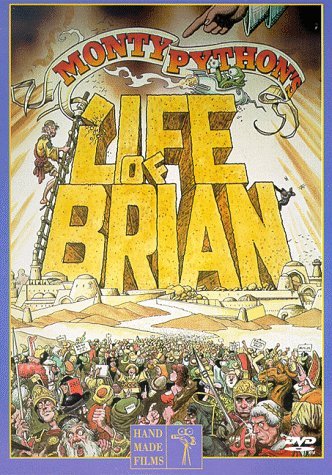
REVIEW: Life of Brian


I had already seen virtually this entire film, but never all-at-once. Life of Brian is a popular flick for cable channels like IFC to air, so I’d previously seen bits and pieces of this movie in a non-linear sequence across 10-years. But this was the first time I sat down and watched the entire movie from start to finish.

Frankly, the most impressive thing about Life of Brian is that it was made at all. Well, maybe not that it was made at all. I mean that it is amazing that Life of Brian was made and looks how Life of Brian looks. I’m saying it looks good. It looks expensive. It looks like any other feature length film released in 1979 looks. It’s a movie that clearly had a significant budget, which is remarkable considering the abhorrent content of the film.

So abhorrent that the movie was banned in countries all around the world, and protested by picketers at theaters in the countries where it wasn’t banned. Surely such a reaction was foreseen when the concept for the movie was first considered. The movie is set up as a 94-minute parody of the theological beliefs that billions of people hold dear. Surely the Monty Python crew knew that if the movie ever got made, people would be pissed. But even if they didn’t, how is it that the studio executives who bankrolled the film didn’t forecast an incensed reaction?

Generally, the established pattern of the relationship of budget to non-offensiveness of content in movies looks something like this: At the intersection of “Budget” and “Non-offensiveness of content” you’ll find really weird porn that you can only find in Germany and Japan. Then, as you move up the curve, you find regular conventional porn. Followed by strange art house movies, not unlike ones made by Crispin Glover that feature a cast made up entirely of adults with Down Syndrome. At the very end of the curve, where there’s a large budget and a high degree of non-offensive content, you’ll find movies like Avatar or Toy Story. Stuff like that. Where you can bring the kids.

Life of Bryan, while not wholly pornographic (although it does feature full frontal shots of Graham Chapman and Sue Jones-Davies), is wholly disrespectful of organized religion. Particularly Christianity, whose cohorts, tend to be the most vociferous (topped only by cohorts of Islam). Considering where it ranks on the chart for “Non-offensiveness of content,” the movie should have had a budget just above a soft-core adult film (specially when you consider the presumably uptight mores people had in 1983, the year that preceeded the election of Ronald Reagan). But just look at the movie. It had to have cost millions. Look at the costumes. Look at the extras. Look at the sets. All that stuff costs a lot of money. It’s a remarkable feat that this movie got made and made to look the way it does. Not only are the members of Monty Python candidates for comedic brilliance, but pecuniary brilliance as well.

I can’t tell if I sincerely liked this movie because it was good, or if I liked it because I dislike religion. Either way, the fact that this movie is still widely discussed makes it mandatory viewing.
THUMBS UP!

3/25/10

REVIEW: Stand By Me (the movie)


One of the more beguiling aspects of watching blockbuster hit films from a few decades ago is knowing what will happen to the actors in the movie several years down the road. ‘Stand By Me’ may be one of the best examples of this (second to ‘The Outsiders’) because of the relatively early age of the actors used. The unusual thing about ‘Stand By Me’s cast is that 24-years later, all of the actors have a noteworthy place in America’s collective celebrity consciousness, except, somehow, for the lead role.

At 15, River Phoenix (vegan) gives an outstanding performance as Chris Chambers, the stalwart leader of the gang. Young River Phoenix is indiscernible from young Geoff Rowley

Little did the viewers in 1986 know, that in a short 7-years in the future, R-Pho would be OD’ing on a West Hollywood sidewalk. But dying young isn't really that bad (if you're a famous actor/musician). Between ages 15 and 23, River Phoenix had already made known to the world the depth of his acting (not musical) ability and had probably nailed more chicks (and dudes) than I’ll ever nail in my life. It’s sad that he died, but, really, what did the future hold for him? Even if he survived that exceptionally powerful bump of Persian Brown, he would’ve only ended up in rehab, and then either found his way into a zealous cult/religion that he would credit with his chemical and spiritual salvation, or onto ‘Celebrity Rehab with Doctor Drew’ after years of hopelessly struggling with substance abuse. He also would’ve inevitably made some grave career missteps along the way which would’ve probably included some poorly received children’s films and at least two discreditable endorsement deal.

Corey Feldman’s (vegan) performance leads the audience to believe, at the time, that he’s a deeply disturbed kid with grim psychological issues that barely come to the surface. Decades later, people now know that that is just Corey Feldman, and not his character, Teddy Duchamp.

Of the four main characters, Jerry O’Connell (law student), is remarkably the only one with a legitimate acting career still intact all these years later. And, for what would be astonishing to the 1986 audience, many of those roles include portrayals of lead alpha male types. Way to go, Jerry!

I don’t know what the fuck happened to Wil Wheaton. I remember him as the baby-faced adolescent that somehow wound up on the Starship Enterprise in ‘Star Trek: The Next Generation,’ but couldn’t really say what happened to him after that.

Richard Dreyfuss is a legend and will undoubtedly be until he dies. Recently, I thought his depiction of Vice President Dick Cheney in Oliver Stone’s ‘W.’ was nothing short of spot on. John Cusack is still a household name, although I can’t imagine his co-starring in ‘Hot Tub Time Machine’ is doing anything to secure that status. And Keifer Sutherland can be seem every Monday night on ’24.’

Actually, there is one actor from ‘Stand By Me’ whose future is far worse than Wil Wheaton’s. If you look up the actor Gary Riley, who played Charlie Hogan
on Wikipedia, you'll find the following paragraph:

"Currently, there is conflicting information regarding the health of this actor. There is a claim that the actor died on June 10, 2007 as a result of an automobile accident. This claim is currently unverified. An alternate explanation regarding this claim is that the person who died had the same name as the actor Gary Riley but was a different and unrelated person[1]. There is presently no information on the Internet that can verify either the actor's death or that the actor is presently alive."

That's bad either way you slice it. Either he is dead, which is bad, or he isn't dead and is totally unable to make it widely known to the public that he is in fact not dead because his cultural status has slipped so far into obscurity that news of his life is deemed hopelessly lackluster to the internet elites. Bummer.

Regardless of the futures of the individuals acting in the film, there's a lot of heart and a compelling story that seems a little campy now, but was probably vanguard at the time. For the most part 'Stand By Me' still holds up decades after it's original release date.
THUMBS UP!

3/24/10

REVIEW: Beavers


I’m not entirely sure this was a real documentary. I feel like it may have been staged. Like ‘Death of a President’ or ‘This is Spinal Tap.’ It’s hard to believe that famed IMAX cinematographer Andy Kitzanuks actually went into the remote regions of the Canadian Rockies in the mid-80’s and shot this movie. Presumably all on film reels. It looks like it was shot on a sound stage in LA with Pomeranians in beaver costumes.

There’s certain shots that seriously bring into question the authenticity of this film. One is where there’s a nighttime shot of a fox along the banks of the river. While the fox is standing there motionless, the camera pans to the right, which makes you think for a moment that the camera is intentionally moving away from the fox, but then, as if on cue, the fox turns as walks in synchronicity with the panning camera. In another shot, the camera follows a beaver swimming underwater up into the inner secure compartment of his beaver dam where his beaver babies are being tended to by their beaver mom. The dam is filmed like a classic sitcom where 3-walls of a living room are intact leaving the fourth wall open to cameras. Like an ant farm. This shot is completely impossible for two reasons: (1) There’s no way beavers would build a dam with a cavernous area that allows for an uninhibited camera to shoot a single transitional shot from underwater to inside the dam; and (2) Even if beavers did somehow incidentally allow for such a pathway to exist in their dam, they certainly would have noticed the camera (and probably camera man) zipping through their domicile and reacted to it. The beavers just act normal. Like it’s Steve Urkel casually having a conversation about human genome alteration with Carl Winslow in the Winslow family living room.

Assuming it’s all real, the camera work is worth the viewing experience, but what the “documentary” has in forehead-slapping cinematography, it lacks in actual conveyance of factual narration. Beavers runs for 33-minutes, but only contains about 5-minutes of dialogue from the narrator. They don’t even attempt to cover the basics, like if beavers mate for life? How long can beavers hold their breath? Do beavers give live birth or do they hatch from eggs? Why are the beavers constantly making noises like their hostages with gags in their mouths? Is that their language? I know all these questions could be answered with a simple Wikipedia search, but this movie came out in 1988, which means a lot of 4th graders on school field trips left the IMAX Theater feeling academically unfulfilled and even though they sat through 33-minutes of non-stop beaver action, they intellectually have nothing to show for it.

All and all, the stunning camera shots make it all worthwhile. It’s such a visual spectacle that even if the movie was totally silent, it would still be worth a viewing.
THUMBS UP!